Answer to mind teaser #8
I HAD NO SHOES AND I PITIED MYSELF. THEN I MET A MAN WHO HAD NO FEET, SO I TOOK HIS SHOES. ~Dave Barry
A FANATIC IS A PERSON WHO CAN'T CHANGE HIS MIND AND WON'T CHANGE THE SUBJECT. ~Winston Churchill
THE INTERNET IS A GATEWAY TO GET ON THE NET. ~Bob Dole
here is the encryption scheme used
A=L
B=G
C=Q
D=S
E=V
F=K
G=O
H=Z
I=U
J=F
K=M
L=C
M=E
N=B
O=X
P=A
Q=R
R=D
S=J
T=Y
U=W
V=H
W=T
X=I
Y=N
Z=P
Mind teaser involving cryptography part 2
Some cryptographic puzzles may be a bit hard for you, but that’s okay – you haven’t learnt everything you need to know about mind teasers that involve cryptography. In fact, there are many techniques used to devise cryptographic mind teasers. Today, we will be looking at a cryptographic technique known as caesar’s box. It is named a Caesar’s box after Julius Caesar, the man who first used the technique
The fist thing you do when you have a short-looking puzzle that you cannot solve by letter/number substitution is to count the number of letters. If the number of letters is a square number, then you probably have a caesar’s box. For example, the code:
G T Y O R J O T E O U I A B G T has 16 letters (4 squared). Divide the line into the number you square to get the number of letters in the mind teaser. For example, the above code will divide into
G T Y O R J O T E O U I A B G T
Next, write it out in X rows of X letter where X is the number you square.
In the example, this becomes:
G T Y O
R J O T
E O U I
A B G T
Now read top to bottom, left to right to read the ‘hidden’ message. The above code says: GREAT JOB YOU GOT IT
You can do this, as long as the number of letters is a square number (the reason for the ‘Box’ in the name Caesar’s Box)
Now you can see how easy it is, why don’t you give it a go?
Mind teaser #9
Andrew Richardson, deputy head cryptographer at a top department of defence (DOD) facility, was working late one night. The last set of codes he received to decipher came from NASA 's space station. Apparently they had been receiving the same 5 set of codes over the past week on a high frequency band in visual digital format. They read...............
wmoa eemn cfuu orrs
wkia eesn ltpe ihlt
hwth oeno pgem eewe
wsta auob rnpl ispe
aust lmmd laui hnse
"Strange," Andy thought. "Never received work from this site before."
Eager to finish and get home, he set to work on figuring out the troublesome codes. The first one took him some time .............
WE COME FROM URANUS.
"What!" he laughed. He thought it was a joke or that he had deciphered incorrectly. However he continued using the same template, and by the time he'd finished he wasn't laughing anymore. He quickly picked up his phone and dialed his director and then the head of the DOD. Somehow he knew he wasn't going home tonight.
What did Andy find that got him so worried?
Wednesday, March 21, 2007

Wednesday, March 7, 2007
mind teasers that involve cryptography
Mind teaser involving cryptography – how do I solve them?
The first question is: what is cryptography?
Cryptography is the use of replacing letters and words to hide the meaning. This means that cryptographic mind teasers require a little bit of thought. Once you have solved one bit, or applied a little bit of logic, then the rest requires a little bit more work based on thew work you have already done to solve it. Most cryptographic mind puzzles involve simple substitution. Here is this week’s one:
Mind teaser #8
The following humorous quotes are from various people. Try and decipher them. U=W and T=Y
X VPR YG DVGMD PYR X ZXWXMR KTDMAJ. WVMY X KMW P KPY UVG VPR YG JMMW, DG X WGGF VXD DVGMD.
P JPYPWXL XD P ZMQDGY UVG LPY'W LVPYBM VXD KXYR PYR UGY'W LVPYBM WVM DINSMLW.
WVM XYWMQYMW XD P BPWMUPT WG BMW GY WVM YMW.
Here’s a Hint to get you going
P=A
M=E
X=I
G=O
I=U
The first question is: what is cryptography?
Cryptography is the use of replacing letters and words to hide the meaning. This means that cryptographic mind teasers require a little bit of thought. Once you have solved one bit, or applied a little bit of logic, then the rest requires a little bit more work based on thew work you have already done to solve it. Most cryptographic mind puzzles involve simple substitution. Here is this week’s one:
Mind teaser #8
The following humorous quotes are from various people. Try and decipher them. U=W and T=Y
X VPR YG DVGMD PYR X ZXWXMR KTDMAJ. WVMY X KMW P KPY UVG VPR YG JMMW, DG X WGGF VXD DVGMD.
P JPYPWXL XD P ZMQDGY UVG LPY'W LVPYBM VXD KXYR PYR UGY'W LVPYBM WVM DINSMLW.
WVM XYWMQYMW XD P BPWMUPT WG BMW GY WVM YMW.
Here’s a Hint to get you going
P=A
M=E
X=I
G=O
I=U
Wednesday, February 28, 2007
Mind illusions - a form of mind teaser with no solution
Mind illusions – seeing things in a different way.
Mind illusions are a funny thing. Sometimes somebody sees one thing, somebody else sees another. A mind that can see things laterally may or may not be able to see both. There are a number of common 2-way mind illusions such as the old woman/young lady, face/vase, among others. These are there to show perceptions – a way of showing that sometimes the information given by the eye is not always what the brain receives. This happens because of our perceptions of our surrounds, and because of conflicting visual cues. Such illusions tease and tantalise the mind. Here is the one for this week:
Mind teaser #7

There are two images here – a duck and a bunny. Can you see both?
Thursday, February 22, 2007
Answer to mind teaser # 5, Mind Illusions Part 1
Answer to mind teaser #5
Up for grabs.
How do I answer mind illusions?
You can’t answer mind illusions. They are designed to tease your mind and distort your perception. Optical illusions rely on your eyes to tease you mind. There are two types of optical illusions. One of these has two ways of looking at the same picture, the other has a way of making the impossible look possible, although your mind does get tricked. The former is more common as it is used to show you that there is more than one way of looking at a picture. The latter is usually used to show how the mind can be easily fooled by the senses. They are sometimes called Esher Illusions, after MC Esher, the man who popularised them with his works. This week, we will feature an optical illusion known as Blivet (aka, the impossible trident illusion)
Mind teaser/illusion #6
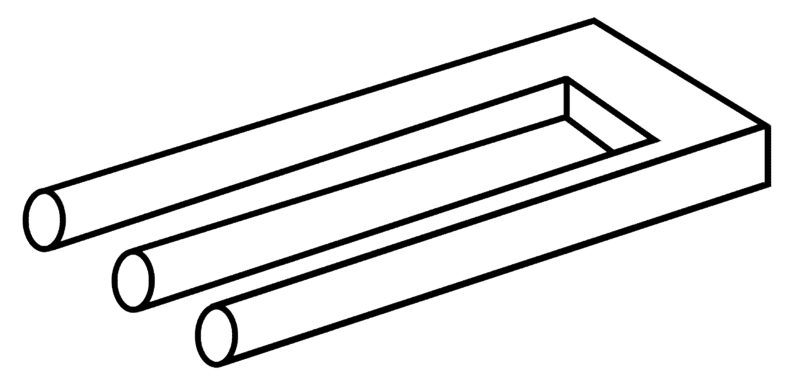
There will be no solution to mind teaser/illusion #6 as there is nothing to solve. Just ponder the image for this week, and wonder where the middle fork joins.
Friday, February 16, 2007
answer to mind teaser #4, answering rebus mind teasers
Answer to mind teaser #4
Rebus mind teasers are usually words or letters put in interesting combinations and positions to represent a word, words or phrases. Sometimes pictures are used to the same effect, though usually in combination with words and letters. The trick with these is to think laterally – the phrase or words are hidden in the rebus. Sometimes, the rebus looks strange, but look deeper into the mind teaser – there is an answer there. Think of what the combinations of letters, words and sometimes objects, could represent.
Here is the mind teaser for this week
Mind teaser # 5

Friday, February 9, 2007
Anser to mind teaser #3, answering mind teaser involving riddles
Answer to mind teaser #3
Since Itchy saw one of the dice, the other one is either a six (1/6 chance) or a non-six (5/6 chance.)
This means that if the scenario is repeated several times over, you would expect that on 5 out of every six occasions there would be one six and one non-six on the board in which case the hidden die is not a six. On the sixth occasion there are 2 sixes on the board so that either one may be revealed and still leave one six hidden. That means that out of every 7 occasions where a six can be revealed, 2 will result in a six remaining hidden.
Answer: Probability = 2/7
How do I answer mind teasers in the form of riddles?
This forces you to think logically, and laterally. It is not always easy to see the answer to these types of mind teasers, so the best way to solve these ones is to practise a lot.
For example, the riddle: Where will you find roads without cars, forests without trees and cities without houses?
It is not easy to see the answer at first. It forces your mind to ponder what it is.
In fact, the answer is: a map.
There is simply no way to teach this. It is a matter of perception and practise. To help you practise, here is this week’s mind teaser.
Mind teaser #4
Strange Death
A man and a woman were driving in their car when it broke down. The man decided to go for help at a gas station a few miles back. He made sure nobody was in the car, rolled all the windows up, and locked all of the sedan's doors. He went off, but when he came back, his wife was dead, and there was a stranger in the car. No physical damage was done to the car, so how did the stranger get in?
remember - answer comes in week's time.Friday, February 2, 2007
Answer to mind teaser #2, Answering mind teasers involving probability
answer to mind teaser #2
Jenny -
Bob - Banana - Tuesday
Kate - Apple - Friday
Joseph - Grapes - Monday
When the mind teaser is given to you, it will ask ‘how likely’, ‘what are the odds’, ‘what is the probability’, etc. These types of questions will tell you that probability is involved.
How do I answer mind teasers that involve probability?
That’s simple. You probably have worked with probability a little bit in high school. This is all you will need when solving mind teasers that require probability. You also need logic in order to solve the mind teaser – some are not as straightforward as it looks.
Here’s this week’s mind teaser to keep you going.
Mind teaser #3
Itchy and Scratchy are playing Backgammon, which requires two identical dice to be rolled on each turn. Scratchy rolls the dice but just as they come to a halt on the board he covers them up with his hands.
"You can't look," screams Scratchy.
"Too late," yells Itchy. "I saw one of them and it was six! Show me the other one." Scratchy at first declines the offer but Itchy applies a gratuitous amount of violence with a chainsaw resulting in the amputation of one of Scratchy's arms, revealing one of the dice. As you may have guessed the revealed die is of course a six. What is the probability that the still hidden die is also a six?
Subscribe to:
Posts (Atom)


